

October 26, 2026 · 14 min read
Shoulder Referral Options in Dallas–Fort Worth: A Physician’s Guide to RegenOrthoSport
Medically reviewed content from RegenOrthoSport, Dallas, Texas.
Start a RegenOrthoSport referral packet
Use a referral packet as a practice-fit handoff: identify the shoulder concern, attach the information already available, record the patient’s interest in non-surgical options, and confirm payment and consultation-format expectations before requesting a consultation. The packet asks the receiving practice to review the information; it does not select a procedure or promise an outcome.
Clinical readiness starts with the patient’s history, attention to red flags, and clinical examination. Use the history to describe onset, mechanism, time course, functional effect, and changes in symptoms. Use the examination to frame the suspected shoulder problem rather than sending a procedure label by itself. This approach gives the receiving clinician a clinical question to assess instead of an assumption to accept.
Our practice typically sees people seeking non-surgical options for joint pain, sports injuries, tendon or ligament damage, and degenerative orthopedic conditions. Consultations and procedures take place at our Dallas office on Walnut Hill Lane, and we offer telehealth and phone consultations for patients who travel to see us.
The two-stage screen leads to a practical decision. First, organize the shoulder concern and identify what remains uncertain. Next, decide whether your patient wants a consultation about non-surgical regenerative options and understands that clinical suitability is determined after assessment. If both conditions are met, send a referral that preserves the clinical question rather than promising a particular pathway.
Complete the clinical information page
Use the packet cover line to state the shoulder question, such as suspected rotator cuff involvement, persistent tendinitis, an injury affecting function, instability, or another shoulder disorder. Name what the consultation should address, and keep the treatment label in the patient-request field.
A referral becomes more useful when it includes a concise clinical sequence:
- Describe when symptoms began and whether a specific event preceded them.
- Record the activities or movements that affect function.
- Summarize relevant examination findings and the red-flag review.
- State what has already been assessed and what remains uncertain.
- Identify whether your patient is seeking evaluation of non-surgical options.
This information does not diagnose the shoulder condition. It gives the receiving clinician a defined starting point for assessment.
To make the handoff consistent, organize the referral under four labels:
- Clinical question: State the shoulder concern being assessed and what the consultation should clarify.
- Supporting record: List the symptom course, relevant examination findings, red-flag review, and each available imaging study with its date and reported purpose.
- Patient request: Record whether the patient wants an evaluation of regenerative options, rather than documenting a procedure as already selected.
- Practical expectations: Note the Dallas consultation context, requested phone or telehealth format if relevant, and the self-pay expectation.
A copy-ready structure can read: “Please evaluate this patient for [shoulder concern]. History and examination: [key findings and red-flag review]. Imaging: [study, date, relevant report, and clinical question]. The patient is seeking a consultation about regenerative options. Please review whether that discussion fits the documented condition and the patient’s diagnosis, imaging findings, and overall health, and address relevant limitations, alternatives, risks, and follow-up questions. The patient understands that the practice is self-pay and that a clear quote follows the complimentary consultation before anything is scheduled.”
This format separates evidence from preference and logistics. If a detail is unavailable, label it as unavailable rather than filling the gap with a presumed diagnosis or procedure choice. Use the same headings whether the patient has a confirmed diagnosis or a working concern; in the latter case, label the concern as suspected and state what the assessment needs to clarify. The receiving clinician can then see what is established, what the patient wants to discuss, and what still requires assessment.
The symptom timeline can change the referral question. A sudden change after an event, a gradual pattern, and persistent symptoms without a clear event may lead to different clinical questions. Record the time course without converting it into a diagnosis. Include changes in function, because the consultation needs to relate the shoulder concern to what your patient can and cannot do.
A specialist referral and a treatment request are different documents in practical terms. A referral to our practice can ask whether the patient’s diagnosis and health status fit a regenerative orthopedic consultation. The consultation can then address whether a non-surgical pathway is appropriate. Keep the treatment label secondary to the clinical question, because our physician bases suitability on diagnosis, imaging findings, and overall health.
Write the referral around the unresolved decision: what shoulder condition is being considered, what information supports that concern, and what you want the consultation to clarify. Send the treatment preference as context, not as a predetermined instruction. This gives the consulting physician room to assess the diagnosis and discuss appropriate options.
Label imaging for the referral packet
When a rotator cuff tear is suspected, X-rays are usually used first to assess the bones; they generally do not show the rotator cuff itself. MRI or ultrasound can show rotator cuff soft tissues and help identify a tear’s location and size. MRI may also provide information about tear chronicity and muscle quality. Place the imaging report and images, when available, in the packet with the examination context and symptom pattern.
For some shoulder conditions, specialist assessment should precede advanced imaging, and imaging may depend on an agreed treatment pathway. That sequencing point matters when the available scan does not answer the referral question or when the suspected condition is not yet clear. Do not present an MRI or ultrasound as proof that a regenerative treatment is appropriate. Present it as one part of the information the consulting physician will assess.
A practical imaging handoff names the study, date, reported finding, and clinical question it was intended to address. Add the relevant examination findings and any change since the study. This format helps the consultation focus on whether the diagnosis, imaging findings, and overall health support a non-surgical discussion rather than on the scan alone.
Imaging has a defined role in the referral. X-rays address bony findings, while MRI or ultrasound can show rotator cuff soft tissues when that question is relevant. Advanced imaging may depend on specialist assessment for some conditions. Send what is available, describe its purpose, and allow the consulting physician to decide what the findings mean for the next discussion.
Mark unresolved items for consultation
The AAOS rotator cuff guideline is not a fixed protocol. It says care should reflect independent clinical judgment and the patient’s individual circumstances. In the packet, use an open-status note when findings, imaging, symptoms, or treatment preferences do not point in a single direction. The packet can preserve that uncertainty instead of implying that one label has already settled the pathway.
Before choosing a referral pathway, identify which of these questions remain open:
- Is the diagnosis sufficiently defined for the requested consultation?
- Do the examination findings and imaging address the same clinical question?
- Could the symptoms represent more than one shoulder disorder?
- Does the patient’s health status change the treatment discussion?
- Is the patient asking for evaluation, or has a specific procedure already been assumed?
An open question is not a failed referral. It is a reason to describe the uncertainty clearly and request clinical assessment.
Your referral note should distinguish established findings from working possibilities. State what the history and examination show, identify what the imaging does and does not clarify, and label any suspected condition as a clinical question. This prevents a preliminary impression from becoming an assumed treatment indication.
When the available information points in different directions, request assessment rather than selecting a procedure in advance. The AAOS guideline’s position on individualized judgment supports that boundary. Send the relevant information, name the unresolved decision, and leave the pathway open for the consulting physician’s clinical assessment.
Match the patient to the practice scope
A consultation can address whether the documented condition belongs within a regenerative treatment discussion, what information is still needed, and whether the patient’s circumstances support considering that pathway. The consultation should also leave room for a different clinical conclusion. The AAOS guideline’s warning that care is not a fixed protocol supports keeping the referral question open rather than presenting regenerative treatment as the expected result.
A clear referral note might state: your patient has a documented shoulder concern, the relevant history and examination findings are attached, the available imaging is included, and the patient requests evaluation of non-surgical options. Ask the consulting physician to assess whether regenerative treatment is appropriate for the diagnosis, imaging findings, and overall health. That wording communicates treatment interest without making an eligibility decision in advance.
Our stated scope does not replace a shoulder assessment. A patient may fit the broad reason for consultation and still require further clinical review before any treatment discussion can be narrowed. Refer for evaluation when the patient understands that the diagnosis, imaging findings, and overall health will shape the discussion.
This identifies the clinical leadership associated with the consultation, while the referral still needs to present the patient’s own findings and questions rather than relying on a provider description.
Add stem cell therapy as a patient-request field
Our stem cell therapy involves collecting and concentrating bone marrow from the back of the hip, then injecting it into an injured or arthritic area under ultrasound or X-ray guidance. Keep this description in the treatment-interest field; it does not select the procedure or establish that it fits every shoulder condition or patient.
Your referral should connect any stem cell therapy discussion to the documented shoulder problem. Include the suspected diagnosis, examination findings, imaging, symptom course, and relevant health information. Ask the consulting physician to determine whether the described approach is appropriate for the individual clinical circumstances. Avoid presenting the injection site, guidance method, or treatment label as a prediction of outcome.
A useful consultation agenda separates technical questions from outcome expectations:
- What clinical problem is the proposed treatment intended to address?
- What information supports discussing the treatment for this shoulder condition?
- How would the bone-marrow collection and injection be relevant to the documented anatomy?
- What limitations, alternatives, and follow-up considerations belong in the discussion?
These questions help you and your patient understand the proposed pathway without treating a general procedure description as individualized medical advice.
A stem cell therapy referral should carry two kinds of information: the clinical basis for discussing the shoulder and the patient’s interest in this treatment category. Keep those purposes separate. The procedure description explains what our practice offers; the physician’s assessment determines whether that option belongs in the patient’s consultation.
Add PRP therapy as a patient-request field
In the patient-request field, record PRP therapy alongside the diagnosis under consideration, examination findings, available imaging, and relevant health context. Request a consultation about the documented shoulder concern; do not present PRP therapy as already selected.
Your referral or consultation request can ask:
- Is PRP therapy within the consultation scope for this documented shoulder problem?
- What examination or imaging findings would inform that discussion?
- What treatment objective is being considered?
- What limitations, alternatives, and follow-up questions should be addressed?
- Would the patient’s overall health change the discussion?
These questions establish the subject of the consultation without telling your patient that PRP therapy is indicated or that a particular result should be expected.
PRP therapy should not replace the clinical question. Shoulder evaluation generally begins with history, red-flag review, and examination, while our practice determines regenerative treatment appropriateness from diagnosis, imaging findings, and overall health. Keep those steps visible when your patient asks specifically about PRP therapy for joint pain, tendinitis, or a suspected rotator cuff problem.
A PRP therapy discussion should remain individualized because clinical care is not a fixed protocol. The AAOS guideline states that treatment and diagnosis should reflect independent clinical judgment and the patient’s circumstances. Your role is to provide a well-framed clinical handoff and preserve room for the consulting physician to reach a different conclusion.
If PRP therapy is the patient’s stated interest, record that preference alongside the diagnosis, examination, imaging, and health context. Request a consultation about whether it is relevant to the documented condition. Do not let the requested treatment name substitute for the assessment that must come first.
Confirm payment and scheduling before referring
Diagnosis and imaging belong together in the referral. When a rotator cuff tear is suspected, X-rays generally assess the bones, while MRI or ultrasound can show the rotator cuff soft tissues and help identify a tear’s location and size. Present those findings as clinical information for review, not as an automatic treatment pathway.
Before recommending consultation, note that shoulder-care guidance can have limitations in applicability and that management recommendations may differ; the consulting physician can relate those limits and alternatives to the patient’s circumstances. Do not promise pain relief, improved mobility, healing, or another outcome. Do not imply that a consultation establishes treatment eligibility. The appropriate request is for a physician to assess whether the proposed non-surgical discussion fits the patient’s individual circumstances.
Use a documentation test before recommending the consultation. The handoff is ready for review when it does all of the following:
- Separates established findings from suspected explanations and identifies the question the consultation must answer.
- Records the patient’s interest in regenerative options without treating that interest as a clinical indication.
- Identifies the information the consulting physician should use, including the diagnosis under consideration, available imaging, and overall health context.
- Makes clear that the discussion should address the proposed treatment’s purpose, relevant limitations, alternatives, risks, and follow-up questions before the patient decides whether to proceed.
- States the self-pay expectation without predicting a price or outcome.
If one of these items is missing, document the gap and request assessment of it rather than converting the missing information into a treatment assumption. Where the record is incomplete, specify the absent item, such as an unavailable imaging report, an unclear symptom timeline, or an unstated patient preference, instead of using a generic request. The same checklist can be used when the patient asks specifically about PRP therapy or stem cell therapy: record the named preference, but retain the broader clinical question and suitability review. This criterion is a referral-quality check, not an individualized recommendation; it helps the referring physician send a complete question while preserving the consulting physician’s clinical judgment.
The practical boundary is straightforward: recommend consultation when the clinical question, available information, treatment preference, and self-pay expectation are all clear enough for an informed discussion. If the diagnosis or imaging question remains unclear, say so in the referral and request assessment of that uncertainty. A clear boundary keeps the referral from becoming a promise about treatment or outcome.
The referral fits this consultation pathway when three conditions are present: the patient has a shoulder concern that can be described clinically, the patient wants to discuss non-surgical regenerative options, and the patient understands the self-pay structure. When any condition is unresolved, document the gap instead of presenting the consultation as a predetermined treatment visit.
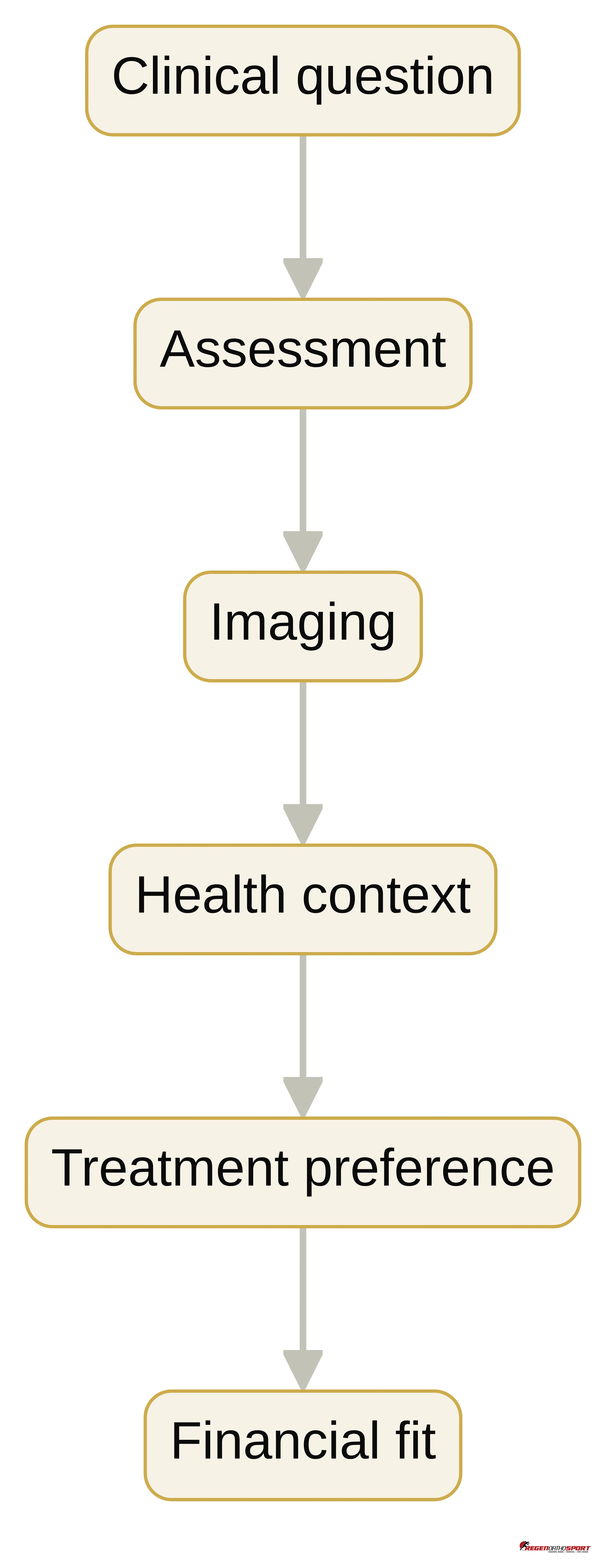
Set self-pay and scheduling expectations early
Our practice is self-pay. Our regenerative procedures are not billed to insurance or reimbursable by Medicare. Include that fact early when your patient is considering a referral, because financial expectations are part of whether the consultation pathway is practical.
We provide a clear quote after the complimentary consultation and before anything is scheduled. That sequence separates clinical evaluation from the financial decision. Your referral conversation can prepare the patient to discuss the proposed plan and quote after the consultation rather than assuming a cost or treatment before the evaluation takes place.
We offer an in-house payment plan, and monthly payment plans are also available through Cherry. These options do not change the need for clinical assessment or establish that treatment is appropriate. Include the self-pay context in the initial conversation so the patient understands that financial planning and clinical suitability are separate parts of the process.
A financially clear referral handoff identifies the patient’s interest in a non-surgical consultation, notes that regenerative procedures are self-pay, and avoids quoting an amount before the complimentary consultation. Our practice provides the quote before scheduling anything. This keeps the referral accurate without turning a financial discussion into a treatment recommendation.
Tell your patient about the self-pay structure before requesting the consultation. Explain that insurance and Medicare do not reimburse our regenerative procedures, that a quote follows the complimentary consultation, and that payment-plan options are available. Then keep the financial discussion separate from the clinical decision about suitability.
Send the packet and confirm consultation logistics
Our consultations and procedures take place at our Dallas office on Walnut Hill Lane, serving patients across Dallas–Fort Worth. We see patients from Fort Worth, Arlington, and the rest of Tarrant County at the Dallas office. Include this office and Dallas–Fort Worth service context in the packet’s logistics field.
We offer telehealth and phone consultations for patients who travel to see us. Use the format that makes the initial conversation practical, while sending the clinical information needed to frame the shoulder question. A concise handoff should include the history, examination findings, relevant imaging, suspected diagnosis, treatment preference, and self-pay expectation.
Before referring, make sure your patient understands that the consultation evaluates fit rather than promises a procedure or result. A qualified clinician should decide individual suitability from the patient’s circumstances, diagnosis, imaging findings, and overall health. If that boundary matches your referral purpose, our Dallas office and available phone or telehealth formats provide a practical way to begin the discussion.
A complete handoff has four parts: the shoulder question, the supporting history and examination, the available imaging, and the patient’s interest in non-surgical options. Add the self-pay expectation and choose the available consultation format. Individual suitability still belongs to a qualified clinician, who can assess the diagnosis, imaging findings, overall health, limitations, and alternatives.
Questions to confirm before making a regenerative shoulder referral
What type of doctor evaluates shoulder injuries?
A shoulder-focused physician evaluates the condition through patient history and clinical examination, identifying specific concerns such as rotator cuff involvement or instability.
How should I prepare a referral for a shoulder consultation?
Include the patient’s history, examination findings, relevant imaging, and the specific clinical question that needs specialist input. This helps the consulting physician assess the situation effectively.
What is the process for initiating a consultation at RegenOrthoSport?
Consultations take place at the Dallas office on Walnut Hill Lane. You can also request telehealth or phone consultations for convenience.
What should I know about the self-pay status of RegenOrthoSport?
RegenOrthoSport operates as a self-pay practice, meaning regenerative procedures are not billed to insurance or reimbursable by Medicare. A clear quote is provided after the complimentary consultation.
What factors should I consider before referring a patient for regenerative treatment?
Consider the patient’s diagnosis, imaging findings, overall health, and whether they are seeking non-surgical options. Ensure the clinical question is well-defined for the consultation.
How does RegenOrthoSport determine treatment suitability?
The physician assesses whether regenerative treatment is appropriate based on the patient’s diagnosis, imaging findings, and overall health during the consultation.
Can I refer patients from outside Dallas for consultation?
Yes, RegenOrthoSport serves patients from across the Dallas–Fort Worth area, including those from Fort Worth and Arlington.