

October 26, 2026 · 24 min read
What Kind of Doctor Should You See for Back Problems in Dallas–Fort Worth?
Medically reviewed content from RegenOrthoSport, Dallas, Texas.
Start by choosing an evaluation, not a procedure
Choosing a doctor for back problems starts with identifying the question you need answered, not selecting a procedure in advance. You may need a general medical evaluation, a musculoskeletal assessment, a spine-focused opinion, or a discussion of non-surgical treatment options. The right starting point depends on your symptoms, history, warning signs, and how the problem affects movement and daily activities.
A primary care clinician can be a practical first contact, especially when you are unsure whether your symptoms involve the spine, muscles, joints, or nerves. A clinician can review your history, perform an examination, and coordinate testing, treatment, or referral when needed. A spine-focused or musculoskeletal clinician may be a more direct fit when your concern already centers on a known spine or disc problem.
Your first appointment should help clarify three things:
- What findings need further assessment?
- What treatment categories fit the clinical picture?
- Which clinician or service should guide the next decision?
Self-management remains part of back care, but self-management does not mean managing without health care. It also includes knowing when to seek assessment, symptom guidance, or advice. A consultation can give you a clearer basis for choosing what to do next instead of asking one treatment to answer every question.
A useful first appointment does not have to produce a final treatment decision. It should give you a structured understanding of the problem and identify the next question that needs an answer.
A chronic low back pain review also found that responses vary widely and that current evidence does not reliably identify in advance who will respond best. Those findings do not identify one universal clinician or treatment for every back problem.
Start with an evaluation that can match the clinical question to an appropriate next step. If your concern is ongoing back pain, a suspected disc problem, or a possible spine condition, explain that concern when you schedule rather than naming a treatment as the answer.
A primary care clinician can be a practical starting point
A primary care clinician can be a practical starting point when you have lower back pain and do not yet know which specialist fits. Primary care can begin the diagnostic evaluation, assess the problem, discuss initial care, and refer you to a spine specialist when that becomes appropriate.
This route can make sense when your symptoms are new, when you have several health concerns to consider, or when you are uncertain whether the source is spinal, muscular, joint-related, or nerve-related. It can also help place the back problem in the context of medications, previous conditions, work demands, and general health.
You do not need to arrive with a diagnosis. You need to describe what you are experiencing and what you want clarified.
That distinction keeps the first visit focused on assessment rather than on proving that a particular specialty or treatment is needed. Describe where the problem is, when it began, how it affects movement or daily activities, and what care you have already tried. If the clinician identifies a need for focused testing or referral, the initial evaluation provides a reason for that next step. If not, you still have a clearer basis for discussing self-management, exercise, or other appropriate care categories. This makes primary care a coordination point, not merely a place to request a referral.
A primary care visit may be useful when you want to answer questions such as:
- Does this problem need a focused spine evaluation?
- Do the symptoms suggest nerve-related involvement that needs assessment?
- Is imaging appropriate at this stage?
- Would physical therapy, exercise guidance, medication discussion, or another clinician be a reasonable next step?
A clinical evaluation can review your history, perform an examination, and screen for warning signs or nerve-related symptoms. That information gives a referral more purpose. Instead of asking for any available back treatment, you can ask for the type of evaluation that matches the findings.
Bring a list of current medicines, prior diagnoses, relevant reports, and the main activities your back problem affects. Those details can help organize the first discussion.
Different clinicians contribute at different points in the care pathway. A primary care clinician may identify findings that call for further evaluation, while a musculoskeletal clinician may assess a more focused presentation. The pathway can change as your symptoms, examination findings, or level of concern become clearer.
Choose primary care first when you need broad coordination or do not know which specialty fits. Choose a more focused appointment when you already have a defined spine-related question and the provider can address that question.
When a spine-focused or musculoskeletal clinician may fit the question
A spine-focused or musculoskeletal clinician may fit your question when your concern already involves persistent back symptoms, a suspected disc problem, reduced movement, or a condition that needs more focused assessment. Musculoskeletal clinicians can contribute to evaluating spinal conditions, including recognizing findings that may require further assessment.
The useful question is not simply which title sounds most specialized. The useful question is what you need the appointment to clarify. You may want help understanding whether symptoms appear related to the spine, whether a nerve-related pattern needs attention, whether function is being affected, or which treatment categories deserve discussion.
Write that question down before the appointment. A clear question can make it easier to tell whether the consultation addresses your concern.
The level of concern identified during assessment can influence who becomes involved next. The cited clinical framework explains that different clinicians encounter different levels of serious spinal pathology depending on where they work in the care pathway. That does not mean a specialist is required for every symptom. It means your history and examination help determine whether a broader evaluation or a more focused referral is appropriate.
A spine-focused appointment can be useful when you already have prior imaging, a previous diagnosis, or symptoms that have continued despite earlier care. Bring those records if they are available, but do not assume that an old label answers the current question. Symptoms and function can change over time.
A prior disc finding may be part of the discussion, but it should be considered alongside your current symptoms and examination.
That is why the most useful records are not only the scan result, but also the report date, the symptoms present at the time, and what care followed. This context helps the next clinician compare the earlier concern with your current function and decide whether the old information answers today’s question. If it does not, the clinician can explain whether a different assessment, referral, or treatment discussion is warranted. You can also note whether the earlier finding was linked to a specific recommendation, rather than assuming that every reported abnormality requires the same next step.
If you are unsure where to begin, choose the clinician who can perform an appropriate assessment and explain when another opinion is needed. Self-management includes knowing when to consult for diagnostic assessment, symptom relief, or advice.
Use a focused evaluation to connect your symptoms with the next decision. Do not choose a procedure merely because a previous scan used a familiar term.
Sports-medicine, pain-management, and surgical consultations serve different purposes
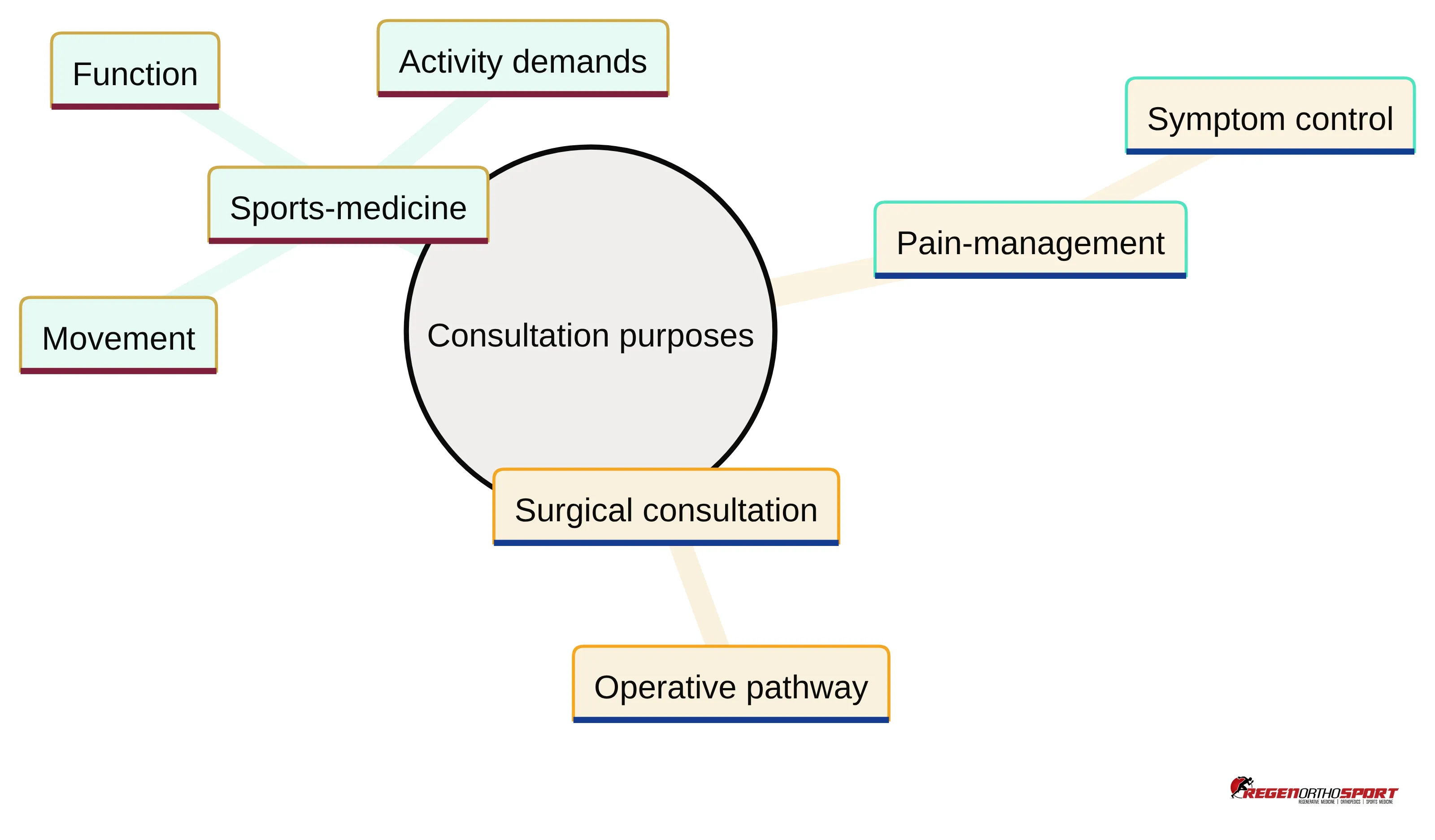
Sports-medicine, pain-management, and surgical consultations can answer different questions, so your reason for seeking care matters. A sports-medicine or other musculoskeletal consultation may focus on movement, function, activity demands, and conditions affecting the spine and surrounding structures. A pain-management consultation may focus on how symptoms are affecting you and which supported approaches can be discussed for symptom control. A surgical consultation addresses whether an operative pathway needs consideration based on the clinical assessment.
These categories are not interchangeable labels for the same appointment. They describe different clinical questions and different points in decision-making. You do not need to choose a procedure before choosing the clinician who can evaluate the problem.
When you contact an office, describe the question you want answered. The purpose of the appointment matters more than selecting the most impressive-sounding title.
Use your main concern to organize the choice:
- You need a broad starting assessment: A primary care clinician can begin the evaluation and coordinate referral or testing when needed.
- You need a focused musculoskeletal opinion: A sports-medicine or spine-focused clinician may be appropriate for questions about movement, function, and a suspected spinal condition.
- You need to discuss symptom-management options: A pain-management consultation may address that specific question.
- You need to understand whether an operative pathway should be considered: A surgical consultation is designed for that decision, not for assuming that an operation is necessary.
Choose the branch that matches the question you need answered, then let the assessment determine what comes next. If the first clinician identifies a different need, follow that referral rather than treating the first appointment as a failed choice.
The clinician best suited to begin an evaluation can depend on your symptoms, history, and the level of concern identified during assessment. Musculoskeletal clinicians can help identify findings that need further assessment, while clinicians farther along the care pathway may encounter more complex presentations.
Keep the choice flexible until the clinical picture is clearer. The goal is not to select a permanent category of care at the first contact; the goal is to reach the assessment that answers your current question.
Why ongoing or changing symptoms merit professional evaluation
Ongoing or changing back symptoms merit professional evaluation because duration, severity, prior episodes, past care, movement, gait, and related factors can change the clinical question. Persistent symptoms do not identify a diagnosis by themselves. They do tell you that a clinician may need more context than a brief description of where your back hurts.
An evaluation can consider when symptoms began, whether they are improving or worsening, how they affect activity, and what you have already tried. It can also consider whether the symptoms follow a pattern that needs further assessment. That information helps separate a general request for advice from a more specific clinical decision.
Changes in function deserve the same clear description as changes in symptom intensity. Tell the clinician what you can no longer do, what takes longer, and what causes you to stop.
Self-management has a place in back care, but self-management does not mean ignoring changes or handling every stage alone. Guidance reviewed across clinical practice recommendations emphasizes education, exercise, staying active, and avoiding prolonged bed rest for appropriate low back pain presentations. The same guidance places those recommendations within an evaluation and care plan, rather than treating them as a substitute for assessment in every situation.
If symptoms continue, return, or change, use that change as a reason to arrange an evaluation. You can bring a short timeline that records:
- When the symptoms began or changed
- Which activities affect your function
- Whether previous care helped, did not help, or had to stop
- Any new symptoms you noticed
- What questions you want answered at the appointment
A timeline gives the clinician a clearer starting point and helps you describe the course of the problem without relying on memory alone.
Chronic low back pain treatments can have different effects for different people, and current evidence does not reliably identify in advance who will respond best. That uncertainty is a reason to discuss the clinical question before selecting a treatment. It is not a reason to stop asking about options.
Arrange professional assessment when the course of your symptoms is not clear or when the problem continues to limit your activities. Use the appointment to discuss both what you can do now and what findings would change the plan.
Warning signs can change the level of assessment needed
Warning signs can change the level of assessment needed, so tell the clinician about symptoms and health circumstances that may raise concern. A clinical evaluation may consider warning signs for serious conditions, nerve-related symptoms, and factors associated with disability risk. The presence of one detail does not establish a diagnosis, but it can affect the next clinical question.
Certain combinations of risk factors, fever, or neurological changes require prompt clinical assessment. The clinician decides whether blood tests, imaging, or specialist consultation is needed based on the overall presentation.
Do not leave out a detail because it seems unrelated to your back. Health history and timing can change how the symptoms are assessed.
Tell your clinician promptly if your back problem occurs with relevant circumstances such as:
- Fever or another sign of infection
- New neurological changes
- A weakened immune system
- Injection-drug use
- A recent spinal procedure
- An indwelling catheter
- An infection elsewhere in the body
- A pattern of symptoms that is changing or difficult to explain
These details help the clinician decide how much assessment is needed. They do not allow you to diagnose the cause at home. Describe when each detail began and whether it changed with the back symptoms.
The relevance of a warning sign depends on its context and on the rest of your history and examination. The clinical framework for spinal conditions emphasizes clinical reasoning rather than treating every warning sign as an automatic diagnosis.
Share the full picture, including timing, severity, previous episodes, and past treatment, and follow the clinician’s direction about the next assessment. When a warning sign is present, prioritize prompt clinical contact over choosing among elective treatment categories.
What an initial consultation may assess
An initial consultation may assess your symptom history, physical function, warning signs, and nerve-related features before treatment options are discussed. The appointment is not only a conversation about pain intensity. It can examine how the problem began, how it has changed, and how it affects movement and daily activities.
Prepare to describe the problem in concrete terms. Location matters, but timing, pattern, function, and related symptoms can matter just as much. A useful account includes what the problem prevents you from doing, not only where you feel it.
Your consultation may cover:
- Timing and duration: When symptoms started, whether they are constant or intermittent, and whether the pattern has changed
- Severity and function: What activities are limited and how movement, work, sleep, or daily tasks are affected
- Previous episodes: Whether similar symptoms occurred before and what happened afterward
- Past care: Treatments, exercises, medications, imaging, referrals, and the response to each
- Movement and gait: Range of motion and walking patterns that may help the clinician understand functional impact
- Relevant psychosocial factors: Work demands, mood, stress, coping patterns, or other circumstances that may affect disability risk
- Neurological features: Symptoms that may suggest nerve-related involvement and need further assessment
Bring medication names, prior reports, and a short symptom timeline when available. Clear details make the appointment more useful. If you do not know a medical term, describe what you notice in ordinary language.
At the end of the assessment, ask which next-step category applies: no additional testing at this point, imaging for a defined clinical question, referral to another clinician, or discussion of available care options. The answer may change as new findings or symptom changes emerge. Asking what would change the plan helps you understand whether the appointment has answered the immediate question or whether another evaluation is needed. It also separates a plan based on current findings from a plan based only on the name of a condition or a requested procedure.
Treatment discussion should follow that assessment. A review of chronic low back pain interventions also found that treatment effects can be small to moderate and that responses vary widely.
Those findings support a conversation about options and conditions, not a promise about what any one treatment will do. Ask how the proposed option connects to your symptoms, examination, and function. Ask what information would lead the clinician to reconsider the plan.
Use the appointment to ask what the clinician believes needs clarification, what can be done now, and what would change the plan. Self-management includes knowing when to seek diagnostic assessment, symptom relief, or advice, so leave with a clear understanding of the next decision.
Before you leave, repeat the plan in your own words. Ask which symptoms or changes should lead you to contact the office again.
When imaging may become part of the evaluation
Imaging is not automatically needed for every chronic low back pain presentation. A clinician may consider imaging when warning signs, a neuromuscular deficit, or symptoms that do not resolve with conservative care make it appropriate.
That means requesting an image is not always the first or most useful step. The clinician first needs to connect the history and examination with the question the image would answer. An image should contribute to a clinical decision rather than become the decision by itself.
If imaging becomes part of your evaluation, ask:
- What clinical question is the imaging intended to answer?
- Which finding from the history or examination led to this recommendation?
- How could the result affect the available treatment discussion?
- Do earlier images still address the current problem, or does the change in symptoms call for a different assessment?
A prior scan may be relevant, but an old report does not automatically explain a new or changing pattern. Bring the report and images when available, and let the clinician decide how they fit the current examination.
Record the date and type of each prior study if you can. That simple list can help the clinician understand what has already been assessed.
The need for further testing depends on the context of the findings. A musculoskeletal clinician can help identify features that require additional assessment, while other clinicians may become involved as the level of concern changes.
Ask what the test is meant to clarify before treating imaging as the answer itself. If the proposed test would not change the next decision, ask how it fits into the overall evaluation.
Treatment discussions should follow assessment
Treatment discussions should follow assessment because the same back symptom can raise different clinical questions. Recommendations describe categories of care, not a personal treatment plan.
A useful consultation connects the proposed option to a specific clinical finding or goal. You can ask what the option is intended to address, what other categories have been considered, and what would lead the clinician to change course.
That sequence protects the decision from being driven by a treatment name alone.
The evidence review of chronic low back pain found that treatment effects are generally small to moderate and that individual responses vary widely. The review also found moderate evidence that exercise provides a moderate clinical benefit, regardless of exercise type.
These findings support choosing an approach through discussion of your presentation and function rather than assuming that a named treatment will fit every back problem. Ask what outcome or function the plan is intended to address and how progress will be discussed.
Before agreeing to a treatment discussion, organize your questions around four points:
- Purpose: What problem or function is the option intended to address?
- Alternatives: What education, exercise, physical, psychological, or medication-based options may also be discussed?
- Conditions: What examination or history findings make the option relevant?
- Next decision: What information will determine whether you continue, change, or stop that approach?
A clinician can use those questions to explain the reasoning behind the plan. You can then decide whether the proposed evaluation matches what you need. Write down the answers so you can compare the plan with your goals after the appointment.
Self-management remains part of the process after a consultation. It includes using the knowledge and skills from the appointment and knowing when to return for assessment or advice.
Keep the treatment conversation connected to your clinical findings, your function, and the next decision. If the discussion moves directly to a procedure without addressing those points, ask which part of the evaluation supports that direction.
Where regenerative medicine, stem cell therapy, and PRP therapy may enter the conversation
Regenerative medicine, stem cell therapy, and PRP therapy may come up when you are exploring non-surgical options for an ongoing musculoskeletal problem, but the discussion should follow a clinical evaluation. Guideline reviews emphasize several non-surgical categories for chronic low back pain, including education, exercise, selected physical therapies, psychological therapies, self-management, and certain medicines.
Those recommendations do not make every regenerative option suitable for every spine or disc condition. If stem cell therapy or PRP therapy is part of your question, ask the clinician to connect the option to the condition being assessed. Ask what findings support discussing it, what alternatives remain available, and what the consultation can and cannot determine.
We use imaging guidance, including fluoroscopy or ultrasound, to place stem cell injections into targeted spinal tissue.
These are provider-specific facts about what we offer, not a determination that stem cell therapy fits your condition. The relevant question is whether an evaluation can address your particular symptoms, history, findings, and treatment goals.
PRP therapy should also be treated as a question for the evaluating clinician rather than as a default answer to back pain. Treatment discussions should follow an assessment, and individual responses to chronic low back pain treatments vary.
Ask whether PRP therapy is relevant to the condition under review, what question it is intended to address, and which other options should be considered. Keep the discussion tied to the clinical problem rather than assuming that the name of a therapy determines its fit.
Current evidence does not reliably identify in advance who will respond best to chronic low back pain treatment. A consultation can help define the clinical question and discuss available options; it cannot turn a treatment category into a predetermined plan.
Use the appointment to understand the reasoning, alternatives, and conditions attached to any regenerative medicine discussion.
What RegenOrthoSport offers in Dallas
Dr. Venkatesh Movva is our founder and medical director. Dr. Movva is fellowship-trained in sports medicine and was a former NCAA Division I team physician.
You can use a consultation to discuss your back problem and the assessment questions that remain. The appointment should focus on your circumstances and the questions that need to be answered.
Our service is one possible provider-specific pathway within a broader back-care decision.
If you are considering our practice, bring the symptoms, records, and questions that will help define whether an evaluation with us addresses what you need. A consultation can focus on discussion and assessment before any treatment decision is made.
We provide consultations and procedures at our Dallas office on Walnut Hill Lane for patients across Dallas–Fort Worth. That local pathway can be relevant if you want to discuss an ongoing back problem and possible non-surgical options with a Dallas regenerative medicine practice.
Use the consultation to explain whether your main need is a general evaluation, a focused spine discussion, or information about our available services.
Consultation formats and practical expectations
Our consultations and procedures take place at 7859 Walnut Hill Ln, Suite 340, in North Dallas. We see patients from Fort Worth, Arlington, and the rest of Tarrant County at our Dallas office.
The location gives Dallas–Fort Worth residents a confirmed local setting for discussing back problems and possible next steps. Include the city you are traveling from when you arrange the appointment so the format can be discussed in context.
We offer telehealth and phone consultations for patients who travel to see us. A remote conversation can give you a way to explain the concern, discuss the records and questions you have, and understand what the next appointment may involve.
The format does not determine whether a procedure or treatment is appropriate. The clinical discussion still needs to address your symptoms and evaluation needs. Ask what information is useful to provide before the consultation and what questions can be addressed in that format.
Prepare for the consultation with a short, factual summary:
- When the back problem began and how it has changed
- What activities are limited
- Previous evaluations, imaging, or treatment
- Current medications and relevant health history
- Questions about stem cell therapy, PRP therapy, or other non-surgical options
- Whether you prefer an in-person, telehealth, or phone conversation
That preparation helps keep the appointment focused on the clinical question rather than on trying to remember every detail in the moment. Bring prior imaging reports and treatment information when available.
Before the appointment, put the most recent change in your summary first, then add the earlier history and previous care. This ordering helps the clinician understand why you are seeking an evaluation now, while the older information supplies context. Keep questions about diagnosis, testing, treatment categories, format, and cost in a single list. You can then mark which questions were answered during the consultation and which require records, another clinician, or follow-up. This is especially useful when you are comparing a general evaluation with a focused discussion of regenerative options.
A consultation is a place to seek assessment, symptom guidance, or advice. It is also a chance to understand what information is still needed before a treatment decision can be made.
Use the appointment to ask what the next step is and what change in symptoms or findings would alter the plan. If you leave with unanswered questions, write them down and ask how they should be addressed.
Understand the self-pay pathway before proceeding
RegenOrthoSport is a self-pay practice. Our regenerative procedures are not billed to insurance and are not reimbursable by Medicare.
This payment structure is part of deciding whether our consultation and services fit your practical needs. Consider the payment pathway alongside the clinical questions you want to discuss.
We provide a clear quote after your complimentary consultation and before anything is scheduled. That sequence gives you an opportunity to understand the proposed service and associated cost before making a scheduling decision.
The consultation is the point to discuss what is being considered, why it is being considered, and what information supports the discussion. You can then decide how the proposed pathway fits your needs before scheduling anything.
We offer an in-house payment plan, and monthly payment plans are also available through Cherry. Payment-plan availability does not change the self-pay status of the practice or the fact that regenerative procedures are not billed to insurance or reimbursable by Medicare.
Include payment questions in the same conversation as your treatment questions. Knowing the payment structure early can help you make a practical decision about whether to continue.
If cost and payment method are part of your decision, include those questions in the consultation conversation. You can then compare the proposed pathway with your clinical needs and budget before anything is scheduled.
A clear financial discussion belongs after the proposed service is explained and before you make a scheduling decision.
Because the quote is provided after the complimentary consultation and before anything is scheduled, ask which proposed service the quote covers and what decision you are being asked to make next. You can also ask how an in-house payment plan or a monthly plan through Cherry relates to the quoted amount. These questions do not change the self-pay structure; they help separate the clinical discussion from the financial decision. If you are deciding whether to proceed, record the quoted pathway and any unanswered questions so you can review them before scheduling.
Use your questions to choose the next clinician
The questions you bring can help you decide whether a primary care clinician, spine-focused clinician, musculoskeletal clinician, or RegenOrthoSport consultation fits your next step. Focus on the decision you need to make rather than on finding a label that promises a particular treatment.
Use this short checklist:
- What needs to be clarified about my symptoms, history, movement, or function?
- Are there warning signs or nerve-related symptoms that change the assessment?
- Does the current situation call for primary care coordination, a focused musculoskeletal evaluation, or another consultation?
- Is imaging relevant to a specific clinical question?
- Which non-surgical treatment categories should be discussed after assessment?
- If I ask about regenerative medicine, stem cell therapy, or PRP therapy, what condition would the discussion address?
- What records, imaging reports, or treatment history should I bring?
Answering these questions before you schedule can help you choose an appointment that matches your immediate need.
Compare your options using shared criteria:
| Question | Primary care clinician | Focused musculoskeletal or regenerative consultation |
|---|---|---|
| What can start here? | Broad history, examination, coordination, and referral | Focused discussion of the spine or musculoskeletal concern and available provider-specific options |
| When may it fit? | When you need a general starting evaluation or coordination | When you want to discuss an ongoing back problem and possible non-surgical regenerative options |
| What should guide the next step? | History, examination, warning signs, and need for referral or testing | History, examination, records, treatment discussion, and whether the provider’s services address the clinical question |
The table is a decision aid, not a ranking. Choose the route that answers the question you have now. If that clinician identifies a different need, use the assessment to guide the next referral or discussion.
We offer telehealth and phone consultations for patients who travel to see us, and we use a self-pay pathway for regenerative procedures.
Use those practical facts alongside your clinical questions when deciding whether to request an appointment. Consider what you want clarified, which records you have, and whether the consultation format works for you.
Do not wait for a treatment preference to replace an evaluation. Self-management includes knowing when to seek assessment or advice, and your next clinician should be chosen around that need.
Make the next appointment about the question you need answered. That approach leaves room for the assessment to guide the treatment discussion.
Request a free consultation to discuss your back problem
Match the evaluation to your symptoms, history, warning signs, and questions about treatment. A qualified clinician must decide whether any specific treatment is appropriate for your condition after reviewing your individual circumstances.
You can prepare by gathering your symptom timeline, previous care information, imaging reports, and questions about non-surgical options. That preparation gives the consultation a clear starting point.
Our Dallas office is located at 7859 Walnut Hill Ln, Suite 340, in North Dallas, and we also offer telehealth and phone consultations for patients who travel to see us. Bring your symptom timeline, previous care information, and questions so the appointment can focus on the evaluation and next decision.
Get Your Free Consultation.
What should I know before requesting a consultation?
What types of clinicians can evaluate back pain or spine problems?
Primary care clinicians are often the first point of contact for back pain. They can perform initial evaluations and refer to specialists if needed. Spine-focused or musculoskeletal clinicians may be more appropriate for ongoing or specific spine-related concerns.
What should I expect during an initial consultation for back problems?
An initial consultation may assess your symptom history, physical function, warning signs, and nerve-related features. It should focus on understanding your symptoms and how they affect your daily activities.
When might imaging be necessary during the evaluation of back pain?
Imaging may be considered when there are warning signs, neuromuscular deficits, or if symptoms do not improve with conservative care. It is not automatically required for every case.
What non-surgical treatment options might be discussed for back pain?
Non-surgical options may include education, exercise, physical therapy, psychological support, and possibly regenerative treatments like stem cell therapy or PRP therapy, depending on the evaluation.
Where is RegenOrthoSport located, and what services do they offer?
RegenOrthoSport is located at 7859 Walnut Hill Ln, Suite 340, in North Dallas. They offer consultations and procedures for back problems, including regenerative treatments.
Is RegenOrthoSport a self-pay practice?
Yes, RegenOrthoSport operates as a self-pay practice, meaning that regenerative procedures are not billed to insurance or reimbursable by Medicare.
How can I prepare for my consultation at RegenOrthoSport?
Prepare by gathering a timeline of your symptoms, previous care information, imaging reports, and any questions about treatment options. This will help focus the consultation on your specific needs.