

October 29, 2026 · 14 min read
Pulled Shoulder Muscle Symptoms: When to Monitor, Seek Evaluation, or Get Prompt Care
Medically reviewed content from RegenOrthoSport, Dallas, Texas.
What Pulled Shoulder Muscle Symptoms Can—and Cannot—Tell You
Shoulder pain has several possible causes, including overuse, wear and tear, injury, and impingement. An acute shoulder injury can involve the joints, rotator cuff, nerves and blood vessels, bones, or nearby tissues.
Use your symptoms as information for the next decision, not as a diagnosis. Three questions can organize what you do next:
- Can you identify a clear injury mechanism? A fall, direct impact, sports contact, or sudden increase in activity changes the concern.
- Has shoulder function changed? Reduced movement, weakness, or difficulty with ordinary activities deserves attention.
- Are neurological symptoms or major trauma present? Those features move the situation away from casual monitoring and toward professional evaluation.
A limited symptom pattern without those concerns may allow cautious monitoring for a short time. Persistent symptoms, reduced strength, restricted movement, or meaningful activity limits support a routine evaluation. Trauma combined with possible bone, joint, nerve, or blood-vessel involvement calls for prompt medical attention. The cause must be determined through an appropriate clinical assessment.
Describe the Symptoms You Are Noticing
Your symptom record should describe what you feel, what you can do, and how the problem began. Those details give a clinician a clearer starting point than the label “pulled muscle.”
Record these details:
- Location: Note whether discomfort is centered around the shoulder, upper arm, or another nearby area.
- Timing: Record when symptoms began and whether they followed a specific activity, fall, impact, or repeated movement.
- Movement: Describe which arm movements are limited and whether the limitation changes during the day.
- Strength: Note weakness during lifting, reaching, carrying, pushing, or other activities that normally use the shoulder.
- Sensation: Record altered sensation, tingling, numbness, or another neurological symptom in the arm or hand.
- Function: List the daily activities, work tasks, exercise, or sport that you cannot perform normally.
- Trend: Describe whether symptoms are improving, staying the same, worsening, or changing in character.
A clinical assessment may review the injury mechanism, discomfort, movement, strength, neurological symptoms, functional limits, and personal goals. Your notes do not identify the injured structure, but they can keep the evaluation focused. Avoid turning one symptom into a conclusion; shoulder problems can share the same outward pattern. A useful record separates symptom description from interpretation. Write “pain with reaching” or “less strength while lifting” rather than concluding that a muscle is pulled. Note whether the change appeared after a specific event or repeated activity, and whether it is improving, unchanged, or worsening. This gives the clinician a timeline and a functional comparison without asking you to identify the structure yourself. Bring the record to an evaluation, especially when symptoms affect work, exercise, sport, or ordinary tasks. The goal is not to prove a strain; it is to make the history detailed enough to guide examination and any next assessment.
Compare Other Possible Shoulder Injuries
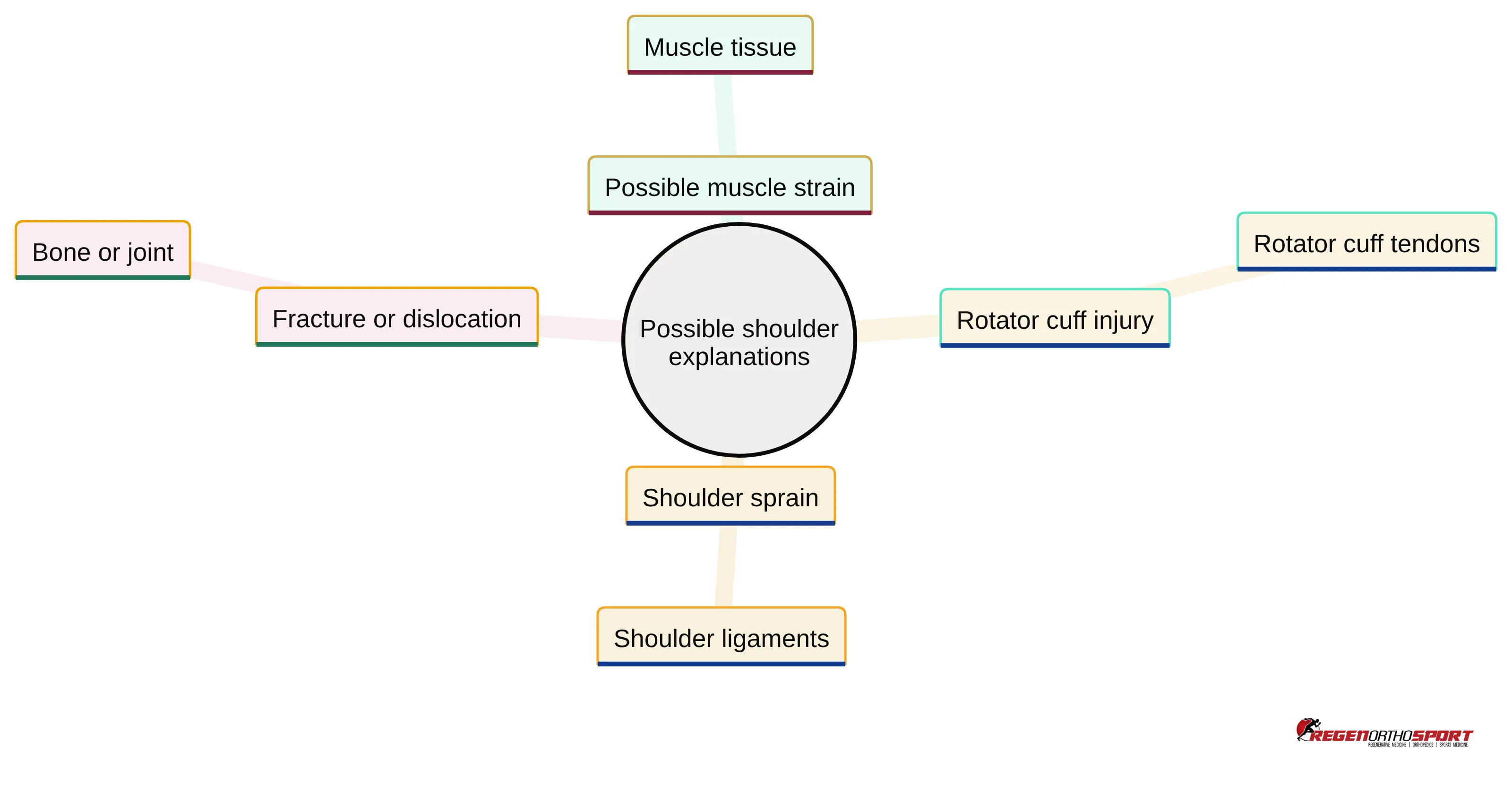
A shoulder muscle strain is only one possible explanation for discomfort after activity, and the same symptoms can arise from tendons, ligaments, joints, bones, nerves, or nearby tissues. Use the comparison below to identify questions for an evaluation rather than to label your injury.
| Possible explanation | Structure involved | Details that may matter | Practical boundary |
|---|---|---|---|
| Do not rely on the label if symptoms persist or function changes. | |||
| Rotator cuff injury | Rotator cuff tendons | Rotator cuff tears can be partial-thickness or full-thickness, depending on how much tendon is damaged. Weakness and limited movement may be part of the assessment. | Arrange an evaluation when strength or motion is meaningfully reduced. |
| Shoulder sprain | Shoulder ligaments | A sprain involves ligaments stretched too far or torn. Falls and sports injuries are common causes. | Describe a fall or sports impact clearly during an evaluation. |
| Fracture or dislocation | Bone or joint | Trauma can cause a fracture or dislocation, while soft-tissue injury can affect muscles, tendons, ligaments, or the joint capsule. | Seek prompt professional assessment after significant trauma or when these possibilities arise. |
The comparison matters because the word “muscle” describes only one tissue. A detailed history and physical examination can help localize the problem and guide the next step. The pattern of symptoms may raise a question, but it cannot settle that question by itself.
Use the Injury Mechanism and Functional Changes as Clues
Your injury mechanism and functional changes provide useful clues, but neither one proves the cause. A fall or direct impact can affect the shoulder joints, rotator cuff, bones, nerves, blood vessels, or nearby tissues. Contact and collision sports are common settings for acute shoulder injuries.
Repeated or demanding activity creates a different history. Overuse can contribute to shoulder symptoms, and overhead movement may aggravate some shoulder conditions. That pattern still does not separate a muscle problem from tendon irritation, impingement, or another injury.
Focus on the change in function:
- Could you raise, lower, reach, or rotate your arm as usual before the symptoms began?
- Did weakness appear with a specific movement or across several activities?
- Did the injury stop you from working, exercising, dressing, or using the arm normally?
- Did altered sensation or another neurological symptom appear with the shoulder problem?
- Has your ability to sleep, train, or complete ordinary tasks changed?
A sudden event plus substantial functional change deserves professional evaluation rather than a self-assigned strain label. If symptoms followed overuse without those changes, reduce aggravating activity and arrange an evaluation if the problem continues, changes, or limits movement or strength.
Recognize Shoulder Symptoms That Need Prompt Evaluation
Shoulder symptoms need prompt evaluation when the history or functional change raises concern for a more significant injury. Do not use symptom monitoring as a substitute for assessment in these situations:
- Significant trauma: A fall, direct impact, or contact injury can involve a fracture, dislocation, or substantial soft-tissue injury.
- Marked loss of movement or strength: A notable change after an injury can help distinguish a simple activity-related complaint from a problem needing examination.
- Neurological symptoms: Altered sensation or another neurological change belongs in the clinical history and should not be dismissed as ordinary muscle soreness.
- Major functional limitation: If you cannot use the arm normally for basic activities, arrange professional assessment instead of testing the shoulder repeatedly.
- A changing pattern: Worsening symptoms, new weakness, or a new limitation changes the question from “Can I watch this?” to “What is causing this?”
Prompt evaluation does not mean that a particular diagnosis is present. It means the possible range of injuries makes a hands-on assessment more appropriate than reassurance based on the symptom name. The possible structures in an acute shoulder injury include joints, rotator cuff, nerves and blood vessels, bones, and nearby tissues. A warning sign therefore changes the need for assessment, not the diagnosis. The history can explain what happened, while the physical examination helps localize the concern. Keep the focus on getting the situation assessed rather than trying to decide which structure is involved from one feature.
Choose Between Monitoring, Routine Evaluation, and Prompt Care
Your next step depends on the symptom pattern, injury mechanism, and effect on function—not on whether the word “strain” sounds reassuring.
Short-term monitoring may be reasonable when symptoms are limited, no significant trauma occurred, no neurological symptoms are present, and you can use the arm without a major change in function. Use rest from aggravating activity and avoid movements that increase symptoms. Set a clear point for reassessment. Seek routine evaluation if the problem persists, changes, or begins to limit movement or strength.
Routine evaluation fits ongoing shoulder discomfort, reduced range of motion, weakness, or activity limits without the prompt features described above. A clinician can review the history, examine movement and strength, and decide whether further assessment is needed. Arrange that evaluation rather than repeatedly testing the shoulder through aggravating activity.
Prompt evaluation fits significant trauma, possible fracture or dislocation, neurological symptoms, marked weakness, or substantial loss of function. Do not monitor these patterns as though they were a confirmed muscle strain.
This three-lane approach does not predict recovery time or select treatment. It organizes how quickly you should move from observation to professional assessment. If you are unsure which lane fits because the symptoms are changing, choose evaluation rather than relying on the most reassuring explanation. Monitoring is therefore an active plan, not a conclusion about the tissue involved. During that period, compare the shoulder with the function you need for ordinary tasks, not only with how it feels at rest. If movement, strength, sensation, or activity tolerance worsens, reassess the decision instead of continuing observation indefinitely.
What a Shoulder Evaluation May Examine
A shoulder evaluation may examine the event that started your symptoms, the structures that could be involved, and the functions that changed afterward. A clinician may ask about:
- how the injury happened and whether it involved a fall, impact, sports activity, or repeated use;
- where you feel symptoms and how they change with movement;
- shoulder range of motion and strength;
- neurological symptoms or altered sensation;
- limits at work, during exercise, or in daily activities; and
- your goals for returning to those activities.
The physical examination helps localize the problem and compare movement and strength with the symptom pattern. A comprehensive history and physical examination can guide the next step without assuming that every shoulder complaint has the same cause.
Bring your symptom record, the date or setting of the activity, and a list of movements that changed. Include any previous shoulder injury or evaluation if it affects the current problem. That information can make the assessment more specific. The symptom label alone cannot determine what the findings mean. The assessment also helps separate three questions that are easy to combine: what happened, what function changed, and what structure might require closer assessment. The first two come from your history; the third may require examination and, when indicated, imaging. Keeping those questions separate reduces the risk of treating a familiar label as an established cause. Before the visit, write down your main activity goal and the movement that is most limited. This helps connect the clinical findings to the work, exercise, or daily task you want to resume, without asking the evaluation to confirm a diagnosis based on symptoms alone.
When Imaging May Help Clarify the Shoulder Problem
Shoulder imaging may help clarify a structural question after the history and examination identify what needs closer evaluation. The test should match the question rather than replace the clinical assessment.
- Ultrasound can reveal tendon tears or impingement, in which a tendon is caught beneath the shoulder blade during movement.
- MRI can provide a clearer view of shoulder muscles, tendons, and ligaments and can identify conditions such as rotator cuff or labral tears.
Imaging may be useful when the examination suggests tendon or soft-tissue involvement, when symptoms persist, or when the injury mechanism raises a structural concern. The decision belongs to the evaluating clinician, who can interpret the image alongside movement, strength, neurological findings, and function.
Do not treat a scan result as a complete explanation by itself. A finding such as a tendon change still needs to be considered alongside your symptoms, examination, activity limits, and goals. If imaging is recommended, ask what question it is intended to answer and how the result would affect the next step. That question may concern a tendon, muscle, ligament, or possible rotator cuff or labral tear. Asking it beforehand helps keep the scan connected to the history and examination, rather than treating an image as a diagnosis on its own.
General Non-Surgical Care Should Follow the Clinical Picture
General non-surgical treatments should follow the clinical picture rather than a presumed muscle strain. A primary-care review reports that most acute shoulder injuries can be managed conservatively with comfort support and targeted musculoskeletal rehabilitation, but the appropriate plan still depends on the injury and examination.
General measures described for rotator cuff symptoms include:
- Rest from aggravating activity: Reduce movements that increase shoulder symptoms while you arrange the appropriate next step.
- Activity modification: Overhead movements may need to change when they increase symptoms.
- Targeted rehabilitation: Physical therapy can address movement, flexibility, and shoulder strength when it fits the clinical findings.
- Clinician-guided exercise: Discuss shoulder exercises with a doctor or physical therapist before starting them. A general exercise list cannot account for a possible fracture, dislocation, tendon injury, or neurological symptom.
These measures are not a diagnosis and do not establish a recovery timetable. If an activity repeatedly increases symptoms, stop using that activity as a self-test. Arrange evaluation when function does not return or when the symptom pattern changes.
Your activity goal also belongs in the discussion. Returning to overhead training, contact sports, lifting, or work may involve different demands than ordinary daily movement, so describe the activity you want to resume rather than asking only whether the shoulder is “better.” Conservative care is not a single preset program. Comfort support, activity modification, and rehabilitation may play different roles depending on what the history and examination show. Resting from an aggravating movement does not answer whether the involved tissue is muscle, tendon, ligament, bone, or joint. Likewise, beginning exercises because a shoulder feels like a strain can be a poor fit when the cause has not been assessed. Keep the plan tied to the clinical picture and revise it if movement, strength, sensation, or function changes.
Put Rotator Cuff Findings in Context
A rotator cuff finding does not automatically explain every shoulder symptom or determine your next treatment discussion. Rotator cuff tears can be partial-thickness, affecting some tendon fibers, or full-thickness, involving a complete tendon tear.
The distinction matters, but tear size is only part of the clinical picture. Your movement, strength, neurological symptoms, activity limits, injury mechanism, and goals also belong in the assessment. A tear may be present without causing noticeable symptoms, while shoulder symptoms can have other causes.
Nonsurgical strengthening can improve function and reduce pain in some cases involving rotator cuff tears. Cleveland Clinic reports that about 8 out of 10 people with partial rotator cuff tears improve with nonsurgical treatment. That group result does not predict your individual outcome, and it does not remove the need to match care to your findings.
Use a rotator cuff discussion to ask focused questions:
- Is the finding partial-thickness or full-thickness?
- Does it match the weakness, movement limits, and activity changes you described?
- What examination findings support the proposed plan?
- Which non-surgical treatments fit the condition being evaluated?
- What would make the plan need reassessment?
A clinician should connect the imaging, examination, and symptom pattern before you select a treatment path. The presence of a tear does not, by itself, settle what your shoulder needs next. If a scan finding and your functional experience do not seem to match, describe that difference clearly. For example, explain whether weakness, movement limits, or activity restrictions are greater or less than the report seems to explain. The clinician can then interpret the finding with the full symptom pattern instead of using it as the sole explanation.
Discuss PRP Therapy and Stem Cell Therapy Only After Evaluation
PRP therapy and stem cell therapy should be discussed only after an evaluation clarifies what may be causing your shoulder symptoms. A symptom label cannot establish whether either option fits your condition, and it cannot determine the expected result for you.
Cell-based approaches for rotator cuff injuries remain an emerging area of study, including possible applications for muscle-fiber tears and full-thickness tears. That description supports a careful discussion, not a promise of benefit. PRP therapy also belongs after the clinical question is defined; the appropriate conversation depends on the diagnosis under consideration, examination findings, and available treatment choices.
If an evaluation leads to a non-surgical treatment discussion, ask:
- What structure or condition is the proposed treatment intended to address?
- Which findings make the option relevant to your situation?
- What alternatives and limitations should you weigh?
- What follow-up would show whether the plan remains appropriate?
- What practical costs, appointments, and activity restrictions should you understand before deciding?
We emphasize patience, communication with a healthcare provider, and following the recommended treatment plan when choosing a non-surgical shoulder-pain treatment. Each person’s experience with shoulder-pain treatment may vary. Those limits apply to PRP therapy and stem cell therapy as well as to other treatment discussions. Evaluation also gives the discussion a defined target. If the concern is a rotator cuff finding, the conversation can address whether the finding is partial or full-thickness, how it relates to weakness and movement limits, and what non-surgical choices are relevant. If the cause remains uncertain, the first decision may be clarifying the condition rather than selecting a regenerative option. Because cell-based approaches remain an emerging area of study, ask what findings support the proposed option, what limitations apply, and how follow-up would reassess the plan. No treatment discussion can replace assessment of the symptoms and function you actually have. Before discussing a regenerative option, be ready to describe the activity you want to resume, the movement that is most limited, and how the problem began. These details help keep the conversation focused on the condition being evaluated and the practical goal of care, without treating a treatment name as a diagnosis.
Discuss Your Findings With a Healthcare Professional
Your next step should match the pattern you can describe: monitor cautiously only when concerning features are absent, arrange routine evaluation for ongoing weakness or movement limits, and seek prompt care after significant trauma or with neurological symptoms. Bring your activity history, symptom changes, functional limits, and questions about evaluation.
A qualified healthcare professional must decide whether a particular treatment is suitable for your individual findings. We emphasize patient communication, patience, and following the recommended plan, while recognizing that each person’s experience with shoulder-pain treatment may vary.
Frequently Asked Questions About Shoulder Symptoms, Evaluation, and Treatment
When should I seek prompt medical evaluation for shoulder symptoms?
Seek prompt evaluation if you experience significant trauma, marked loss of movement or strength, neurological symptoms like tingling or numbness, major functional limitations, or if symptoms worsen or change.
How can I distinguish between a muscle strain and other shoulder injuries?
Consider the injury mechanism and functional changes.
What steps should I take if my shoulder symptoms persist?
If symptoms persist, arrange for a routine evaluation with a healthcare provider to assess movement, strength, and any underlying issues.
What non-surgical treatments are available for shoulder injuries?
Non-surgical treatments may include rest, activity modification, physical therapy, and guided exercises to improve strength and flexibility, depending on the specific injury.
How does imaging help in evaluating shoulder injuries?
Imaging, such as ultrasound or MRI, can clarify structural issues like tendon tears or impingement, but it should complement a thorough clinical assessment.
What should I discuss with my healthcare provider regarding PRP or stem cell therapy?
Discuss the specific condition being treated, the relevance of the proposed treatment to your situation, and any potential alternatives or limitations before deciding on PRP or stem cell therapy.