

October 26, 2026 · 16 min read
Knee Pain Management: A Dallas Referral Decision Guide for Non-Surgical Options
Medically reviewed content from RegenOrthoSport, Dallas, Texas.
When a Dallas consultation can clarify non-surgical knee pain management
A Dallas consultation can clarify whether a patient’s clinical picture warrants discussion of PRP therapy, stem cell therapy, or another non-surgical treatment. The useful referral decision is not a choice between treatment names based on a diagnosis label alone. It is a structured discussion of the suspected condition, symptom pattern, prior management, goals, evidence limits, and practical circumstances.
The AAOS knee osteoarthritis guideline reviews evidence on non-arthroplasty treatment for clinicians, but it is not a fixed protocol. AAOS notes that treatment should reflect the patient’s clinical circumstances and the clinician’s independent judgment. That distinction matters when you are considering a referral for osteoarthritis, joint pain, or a suspected meniscus or ligament injury.
We do not treat the diagnosis label as the entire decision. A consultation is a place to clarify the working clinical question, discuss available options, and identify what still needs evaluation.
Orthobiologics are sometimes called regenerative medicine. AAOS describes them as promising for conditions such as osteoarthritis while also noting meaningful unknowns about newer treatments and the need for more evidence-based research. That combination calls for measured referral conversations rather than broad claims.
Our consultations and procedures take place at 7859 Walnut Hill Ln, Suite 340, North Dallas. We serve patients from across Dallas–Fort Worth and offer telehealth and phone consultations for patients who travel to see us. Those practical details can help you decide whether a Dallas evaluation is workable for your patient before discussing a possible referral.
Start with the clinical picture behind knee pain
Osteoarthritis affects the whole joint, including cartilage, the joint lining, ligaments, and bone. That broader view helps explain why a knee diagnosis alone does not identify a single treatment path. The clinical question includes symptoms, function, the suspected structure involved, and the patient’s wider health context.
Treatment for osteoarthritis generally aims to reduce pain and improve function. Those aims should remain separate from a promise about what any particular procedure will accomplish. If your patient describes joint pain with reduced function, start by clarifying what activities are limited, how symptoms affect daily life, and which goals matter most to the patient.
Pain in more than one joint can have different causes, including osteoarthritis and inflammatory disease. For patients with pain in multiple joints, evaluation should include a detailed history of symptom characteristics, location, duration, systemic symptoms, and relevant exposures. That history can change the referral question before any regenerative option is discussed.
Use a focused set of questions:
- Where is the knee pain, and when did it begin?
- Has the pattern changed, or has there been a sudden worsening?
- Is one knee involved, or are several joints affected?
- Are there systemic symptoms or other features that broaden the clinical question?
- What prior management has been tried, and was it unsuitable, ineffective, or not tolerated?
- What function does your patient want to regain or preserve?
If the working concern is a meniscus or ligament injury, carry that concern into the evaluation rather than treating the label as proof that a regenerative treatment fits. The referral should follow the clinical question.
Joint redness, warmth, or swelling can suggest synovitis and inflammation. These findings do not establish a final diagnosis, but they can change what needs to be considered before a procedure-focused discussion. Depending on the suspected diagnosis, clinicians may use laboratory testing, joint aspiration, or imaging for confirmation.
A practical boundary follows: do not use an osteoarthritis label to explain every knee symptom, especially when the pattern includes multiple joints, systemic features, marked inflammation, or an atypical course. Clarify the diagnosis first, then decide whether a specialist consultation adds value.
Use history, examination, and targeted confirmation before referral
A referral becomes more useful when it carries a defined clinical question. History, examination, and targeted confirmation can help separate a discussion of knee osteoarthritis from a broader evaluation of joint pain. The purpose is not to force every patient through the same sequence. AAOS describes its guideline as a resource rather than a fixed protocol, and the appropriate diagnostic approach can differ with the patient’s circumstances.
Before sending a referral, organize the information that will help the specialist understand the case:
- The symptom location, duration, pattern, and effect on function.
- Relevant examination findings, including redness, warmth, swelling, range-of-motion concerns, or other findings you have documented.
- Whether one joint or multiple joints are involved.
- Relevant systemic symptoms, exposures, and medical history.
- Prior testing and the specific question that remains unresolved.
- Prior management, the patient’s response, and the reason for considering another option.
- The patient’s goals, preferences, and practical constraints.
Depending on the suspected diagnosis, laboratory tests, joint aspiration, or imaging may be used for confirmation. The choice should follow the clinical question rather than a routine assumption that every knee complaint requires the same test. Radiography is not always required when symptoms and risk factors are typical for osteoarthritis.
This approach also protects the referral discussion from a common category error. A test can describe an abnormality without identifying the best next option for the patient. The specialist needs the history and examination context alongside the test result.
For a primary care referral, a concise summary can state: the working diagnosis, the features supporting it, the features that remain uncertain, the management already attempted, the patient’s goals, and the reason a consultation is being requested. That summary preserves clinical judgment while giving the receiving clinician a clear starting point.
A referral question can be as specific as: “Please evaluate whether this patient’s symptoms and prior management make a discussion of non-surgical regenerative options reasonable, and explain alternatives, material risks, expected recovery, and follow-up.” That wording requests evaluation without presupposing candidacy or a particular procedure.
Use the question to identify the purpose of the consultation, not only the treatment category. A referral may be prompted by diagnostic uncertainty, an atypical symptom course, limited response to prior management, or a patient’s need to understand available options. Those prompts call for different information, even when the requested consultation concerns the same knee. Stating the prompt helps the receiving clinician address the clinical picture first and then explain whether a non-surgical option, another approach, or further evaluation belongs in the discussion. It also makes clear that requesting specialist input is not the same as recommending a procedure.
Do not let imaging alone determine the referral
Imaging findings do not always match the severity of a patient’s osteoarthritis symptoms. A scan can therefore be relevant without settling the referral decision. Compare the image with the symptom pattern, examination, functional effect, and the patient’s goals before treating it as the central fact.
MRI can identify abnormalities in about 90% of adults older than 50 who do not have joint pain, in both obese and nonobese groups. That finding does not make MRI unhelpful. It shows why an abnormal image needs clinical context.
Use imaging to answer a question, not to create one. Ask:
- Does the reported finding fit the location and pattern of symptoms?
- Does it fit the examination?
- Is the finding relevant to the functional problem your patient wants addressed?
- Would another test, laboratory assessment, or joint aspiration clarify a competing explanation?
- What decision would change if the finding were confirmed or absent?
When the image and symptoms do not align, make that mismatch visible in the referral. Diagnostic uncertainty is a reason to clarify the clinical picture, not a reason to equate an imaging finding with treatment candidacy.
The AAOS guideline reviews evidence on non-arthroplasty treatment of knee osteoarthritis, but AAOS also states that care should reflect each patient’s circumstances. This means an imaging report should inform the discussion rather than dictate it. A specialist evaluation can then address whether the suspected condition, prior management, and goals align with a non-surgical option.
Compare established management, PRP therapy, and stem cell therapy without equating them
Established non-surgical management, PRP therapy, and stem cell therapy belong in the same referral conversation, but they are not interchangeable labels. The first task is to identify the clinical problem and the management already attempted. The second is to clarify what a proposed treatment involves and what evidence can reasonably be applied to that patient.
NICE guidance includes appropriate footwear and insoles among measures that may be considered when clinically appropriate. The AAOS guideline addresses non-arthroplasty treatment of knee osteoarthritis as a wider field. PRP therapy and stem cell therapy are distinct orthobiologic discussions within that broader decision, and a discussion of one does not establish that the others are unsuitable.
| Option or lane | What you can clarify | What you should not infer |
|---|---|---|
| Established non-surgical management | Which clinician-selected measures have been tried, whether they were suitable or tolerated, and what remains unresolved | That a general category automatically fits the patient or answers a separate diagnostic question |
| PRP therapy | The exact preparation being discussed, the evidence relevant to that preparation, the intended treatment target, and the proposed follow-up | That one study of autologous conditioned plasma represents every PRP preparation or every patient |
| Stem cell therapy | The cell source, how the proposed procedure is performed, what the consultation is intended to assess, and how uncertainty will be handled | That the name alone establishes candidacy, expected results, or a comparison with PRP therapy |
| Referral evaluation | Whether the clinical picture, prior management, goals, and practical circumstances justify a specialist discussion | That requesting a consultation commits your patient to a procedure |
The PRP evidence requires careful wording because the study summarized by AAOS concerns autologous conditioned plasma. It should not be presented as a universal result for every preparation called PRP. Our stem cell therapy is performed as an outpatient visit, but this process does not establish a general comparison with PRP therapy.
AAOS describes orthobiologics as promising for conditions such as osteoarthritis while emphasizing complexities and unknowns about newer treatments. That is a useful shared standard for the conversation: describe the proposed option precisely, separate evidence from expectation, and leave room for a different recommendation after evaluation.
For your referral note, avoid writing only “knee arthritis—please consider regenerative treatment.” Add the facts that make comparison possible: symptom pattern, functional effect, prior management, relevant health factors, goals, and the question you want answered. The receiving clinician can then discuss whether established management, PRP therapy, stem cell therapy, or another path fits the case under review.
What the available PRP evidence can—and cannot—show
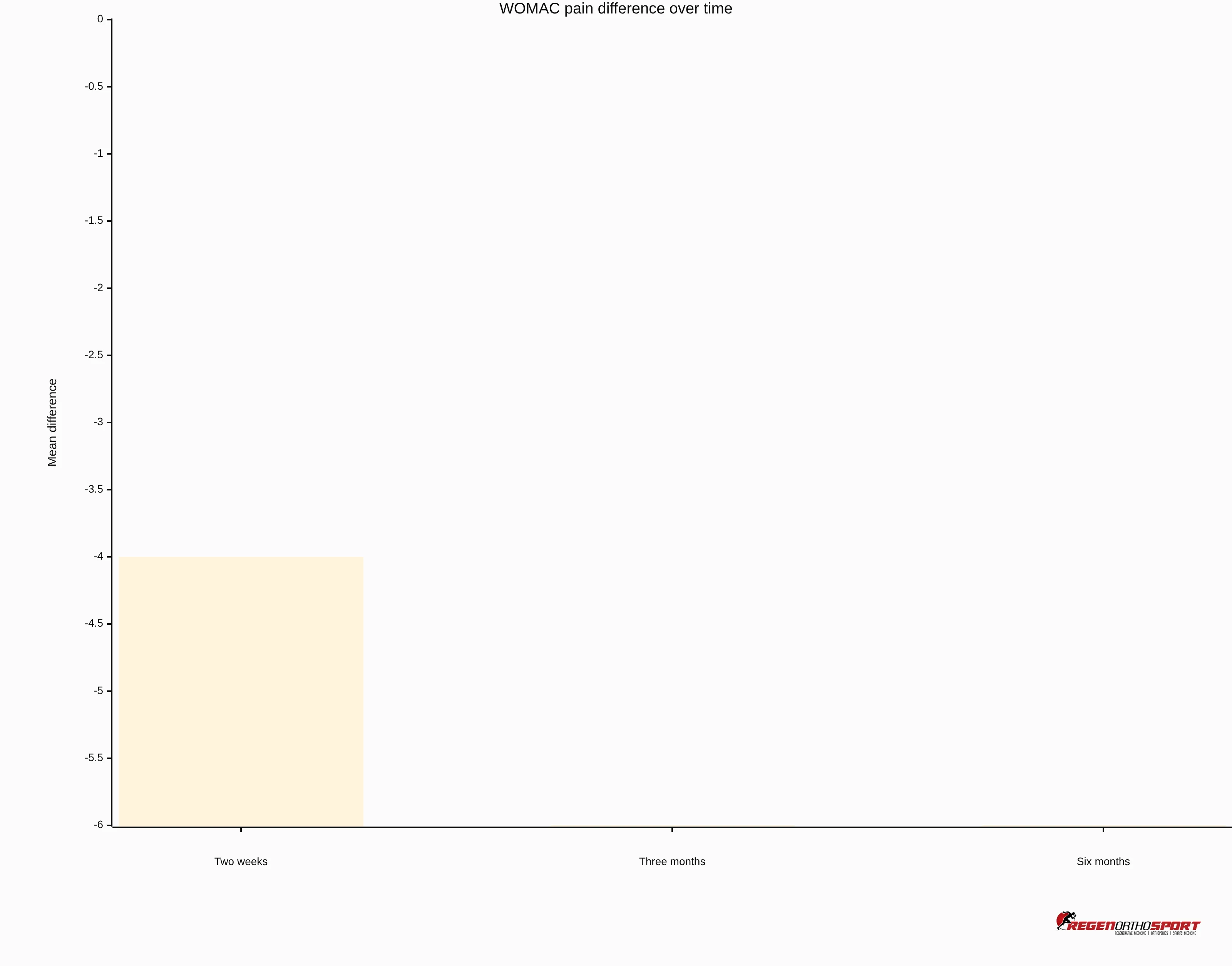
The available PRP evidence includes one high-quality study of autologous conditioned plasma compared with placebo. In that study, the mean difference in WOMAC pain score was -4 at two weeks and -6 at three and six months. The same summary reports a mean difference of -2 in WOMAC stiffness score at two months.
Those numbers describe a study result and the measure used. They do not establish that every patient will experience the same change, that every PRP preparation is equivalent, or that the result answers a different clinical question such as a suspected ligament or meniscus injury.
Interpret the result in layers:
- Population and treatment: identify who was studied and the exact preparation used.
- Outcome: distinguish WOMAC pain from WOMAC stiffness rather than treating them as one measure.
- Time point: note whether the result was reported at two weeks, two months, or three or six months.
- Comparator: recognize that the study compared the preparation with placebo.
- Scope: keep the result attached to that study instead of converting it into a promise for your patient.
AAOS recommends more evidence-based research and physician education for orthobiologics, along with clear information for patients. That recommendation supports a transparent discussion of what the evidence measures and where clinical uncertainty remains.
A useful PRP referral discussion should clarify:
- What exact preparation is being proposed?
- Which condition or symptoms is the proposed treatment intended to address?
- Which outcomes will be tracked, and over what period?
- What alternatives remain available if the plan is unsuitable or does not meet the patient’s goals?
- What follow-up is planned, and what findings would change the plan?
These questions do not predict the result. They help you and your patient distinguish a study finding from an individualized clinical decision.
What a stem cell discussion should clarify
A stem cell discussion should clarify the exact source, procedure, intended target, evidence limits, possible risks, and follow-up before your patient decides whether to proceed. AAOS describes newer orthobiologics as having promise while also noting complexities and unknowns. The name of a treatment does not resolve those questions.
AAOS also advises patients to discuss options with a physician, receive a full medical examination that considers systemic illness, and understand coverage or out-of-pocket costs. Those points are especially relevant when a patient is asking about a newer treatment or is comparing options outside a standard management pathway.
Our stem cell therapy uses concentrated bone marrow collected from the back of the hip and injected into the injured or arthritic area under ultrasound or X-ray guidance. We perform this procedure as an outpatient visit using the patient’s own cells.
That description explains our process. It does not determine whether the process suits a particular patient, establish a comparison with PRP therapy, or predict recovery. The consultation should connect the proposed procedure to the patient’s clinical picture and should address the practical details that affect planning.
Ask the specialist to explain:
- What condition is the consultation evaluating?
- Why is this procedure being discussed for this patient’s clinical picture?
- What does the planned visit involve from preparation through follow-up?
- What restrictions, monitoring, and recovery milestones should your patient expect?
- Which potential risks or patient-specific factors could change the plan?
- What evidence applies to the proposed procedure and target condition?
- What alternatives should remain under consideration?
A focused explanation of the condition, procedure, evidence, uncertainty, and follow-up is a more useful standard for referral discussions.
Identify patients who may warrant specialist evaluation
A patient may warrant specialist evaluation when the clinical question remains meaningful after an initial assessment and a non-surgical option could reasonably be discussed. The decision should account for condition severity, overall health, lifestyle factors, personal preferences, prior management, and the patient’s goals. These factors support a referral conversation; they do not determine candidacy from a distance. Keep two decisions separate. Referral appropriateness asks whether specialist input could clarify the diagnosis, prior management, available options, or the patient’s goals. Treatment candidacy is a later clinical determination that requires evaluation of the individual circumstances. A patient can warrant a consultation because an important question remains open without being a candidate for every option discussed. Recording that distinction helps the referral remain useful and prevents interest in regenerative medicine from being presented as a conclusion.
A referral may be more useful when you can state what needs clarification, such as:
- Whether the symptom pattern fits the working diagnosis.
- Whether a suspected meniscus or ligament injury needs a different evaluation.
- Whether prior management was unsuitable, ineffective, or not tolerated.
- Whether the patient’s functional concerns justify discussing another non-surgical path.
- Whether the patient understands the evidence limits and wants an individualized consultation.
NICE guidance identifies several circumstances that can support orthopaedic referral: substantial effects on quality of life, diagnostic uncertainty or atypical features, initial management that is ineffective, not tolerated, or unsuitable, and sudden worsening. The guidance advises considering referral when non-surgical management is unsuitable or ineffective after three months, based on clinical judgment and the patient’s circumstances.
That guidance comes from the United Kingdom and addresses orthopaedic referral. It should not be relabeled as a rule for regenerative referral in Dallas. It is still a useful decision prompt: document the effect on function, the uncertainty, the response to prior management, and any change in symptoms before deciding how to proceed.
NICE says referral decisions should not be based solely on age, sex or gender, smoking status, comorbidities, or body mass index. If your patient has sudden worsening, atypical features, substantial functional impact, or unresolved diagnostic uncertainty, address that clinical issue directly. Do not use interest in PRP therapy or stem cell therapy as a substitute for clarifying the cause of symptoms.
Set expectations for uncertainty, logistics, and financial discussion
We are a self-pay practice, and our regenerative procedures are not billed to insurance or reimbursable by Medicare. That fact belongs in the referral conversation because payment arrangements can affect whether a patient can pursue an evaluation or proposed procedure.
AAOS advises patients to understand insurance coverage or out-of-pocket costs when considering orthobiologic treatment. For your patient, separate the cost of the consultation from the cost of any proposed procedure, ask what the clinical plan includes, and discuss the financial implications before a decision is made. No price or reimbursement assumption should be added to the referral.
Recovery should be discussed as a patient-specific planning issue rather than a fixed promise. Ask about activity restrictions, monitoring, follow-up timing, and the findings that would prompt a change in plan. The available evidence and the patient’s circumstances may not support a single recovery expectation across PRP therapy, stem cell therapy, and other non-surgical management. Before the visit, ask whether the patient can participate in the proposed follow-up and discuss any practical constraints that could affect planning. If travel is relevant, the practice offers telehealth and phone consultations, while its stem cell procedure is performed as an outpatient visit. Those details can make the consultation easier to plan, but they do not establish that a treatment is clinically suitable. The recovery conversation should remain tied to the specific option, the patient’s circumstances, and the clinician’s instructions rather than a generic timeline.
Use a referral conversation that preserves clinical judgment
A referral conversation works best when it gives your patient a clear reason for evaluation without promising a particular treatment. You can frame it this way: “Your symptoms, examination, prior management, and goals deserve a focused discussion of available non-surgical options. A consultation can clarify which options are relevant, what the evidence can show, and what limitations or alternatives should be considered.”
We encourage patients to prepare a list of questions for a knee-doctor consultation. You can help your patient prepare by organizing questions under four headings:
- Clinical picture: What diagnosis is being evaluated, and what findings support it?
- Options: Which established and regenerative options are relevant, and why?
- Expectations: What are the proposed outcomes, risks, recovery considerations, and follow-up plan?
- Practical details: Where will care occur, what visits are involved, and what financial arrangements apply?
A concise referral note can include:
- The patient’s main symptom and functional concern.
- The working diagnosis and any competing concern.
- Relevant examination findings and testing.
- The duration and course of symptoms.
- Prior management and the response or reason it was unsuitable.
- Relevant systemic symptoms, medical history, and patient goals.
- The specific question for the consultation.
This structure keeps the referral clinically grounded. It also gives the specialist enough context to explain whether PRP therapy, stem cell therapy, another non-surgical approach, or further evaluation belongs in the conversation.
We advise patients to consult a healthcare professional specializing in knee pain management when choosing among treatment options. Together, those points support a referral process that is specific without being predetermined.
Do not describe a referral as proof that a procedure is appropriate. Describe it as a request for individualized evaluation, explanation of alternatives, and a plan that can be adjusted to the clinical findings.
Request an individualized Dallas consultation
The referral decision is strongest when it connects the patient’s symptom pattern, examination, testing, prior management, goals, evidence limits, and practical circumstances. PRP therapy and stem cell therapy should be discussed as distinct options, not as interchangeable answers to a diagnosis label. A qualified healthcare professional must determine individual suitability after evaluating the patient’s circumstances.
We provide non-surgical treatments for patients discussing knee pain, osteoarthritis, and related joint concerns. Dr. Movva is our founder and medical director, and he is fellowship-trained in sports medicine and was a former NCAA Division I team physician. Our Dallas office is at 7859 Walnut Hill Ln, Suite 340, North Dallas. We also offer telehealth and phone consultations for patients who travel to see us, and our regenerative procedures use a self-pay model rather than insurance billing or Medicare reimbursement.
Before the consultation, send the clinical question, relevant findings, prior management, patient goals, and questions about evidence, risks, recovery, follow-up, and cost. That preparation gives the discussion a clear starting point without deciding the outcome in advance.
Questions clinicians may raise before a regenerative knee referral
What should I discuss with a patient before referring them for a consultation?
Discuss the patient’s symptoms, prior management, functional goals, and any questions they may have about the proposed treatments, including risks and recovery expectations.
Where is RegenOrthoSport located and what services do they offer?
RegenOrthoSport is located at 7859 Walnut Hill Ln, Suite 340, North Dallas, and offers consultations and procedures for non-surgical knee pain management.
What should I include in a referral note for a patient considering regenerative treatment?
Include the patient’s main symptoms, relevant examination findings, prior management attempts, and the specific clinical question you want the specialist to address.
What are the expected recovery logistics for regenerative treatments?
Recovery logistics can vary; discuss activity restrictions, monitoring, follow-up timing, and any findings that would prompt a change in the treatment plan during the consultation.
What financial considerations should I discuss with patients regarding regenerative treatments?
Inform patients that RegenOrthoSport operates on a self-pay model, meaning regenerative procedures are not billed to insurance or reimbursable by Medicare.